Quick History of Education: Daily Inspire

Published: Mon, 08/22/11


Daily Inspire!
 
  
A Quick History of Education
 
 
Greece provides us with the history of two very different kinds of education, that of Athens versus Sparta.
 
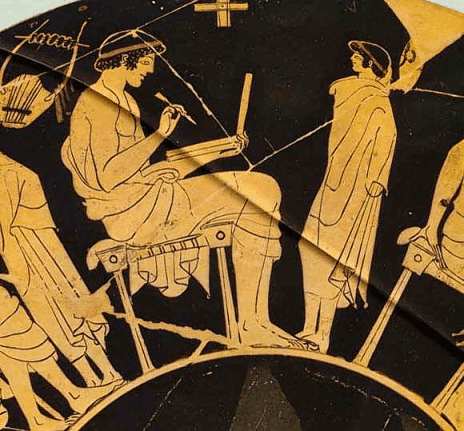
In Athens parents taught their kids directly until about age 7, when they were enrolled according to parental choice in various free enterprise schools and academies.
Anyone could set up a school, offer any curriculum, or do private tutoring. The parents researched various options and sent their children to different educational opportunities as they felt best.
 
Widespread competition kept the price low, since educational attainment was highly valued.
 
There was almost universal education for the young, even among the poorer classes. The wealthy typically hired tutors, while other classes usually sent children to group schools.

The broad curriculum included three major areas of focus: literacy, music and gymnastics. Literacy covered reading, writing and arithmetic, while the broad field of "music" included music, poetry, epic literature, drama and storytelling. Gymnastics emphasized physical fitness.  

During adolescence, typically between ages 14-18, the wealthy young continued studying with tutors while the non-wealthy youth were apprenticed into various trades. Parents made the choices about tutors and apprenticeships.
 
Adolescent studies of wealthy youth often covered oratory, science, higher mathematics, rhetorical writing, and a wide range of specialized topics--depending on the school.
 
The city-state of Sparta, in contrast, adopted a single state curriculum, required all children up to age 18 to attend, and allowed little or no extras beyond the compulsory curriculum.
 
The state appointed the teachers; parents had no say in the education of their youth.
 
At first blush, it would appear that the Spartan model was more fair, inclusive and open for youth from all economic levels and diverse walks of life.
 
The reality is quite different, however...
 ~Oliver DeMille, TJEd.org


Featured Resource


Of all the things you'll spend $10 on each month, This Week in History is not only a great value, but a time saver and a worry eliminator.
 
This Week in History:
  • Relieves fear, stress and burnout
  • Energizes your kidschool
  • Fills in the gaps
  • Cultivates cultural literacy
  • Facilitates state or provincial compliance
  • Correlates resources for co-ops, classrooms and family learning
  • Harnesses the power of technology in a classical leadership education
  • Harmonizes with Unschooling, Charlotte Mason, Montessori, Trivium/Quadrivium, IEW, eclectic, etc.
  • Delivers new ideas and areas of learning to you and your child
  • Instigates discussions and projects that expand wisdom and understanding
  • Connects the subject areas-from music to math, from geography to world religions, from hobbies to science projects, etc.
  • Motivates you and your students to greater excellence
  • Delivers Face to Face with Greatness
  • Empowers you to mentor your students in the classics
  • Enlivens the 7 Keys of Great Teaching
  • Activates Phases of Learning

...so you can "Inspire, not Require"

subscribe button
This Week in History
 
Check these out and you'll see what I mean:
[Click on a date to view a sample of This Week in History]


 What is TJEd?


Every person has inner genius. Thomas Jefferson Education consists of helping each student discover, develop and polish his or her genius. This is the essence and very definition of great education.
 

There are really only three kinds of education, and they are best understood from the student's perspective. Students get a good education for one of three reasons:
 
  • they are forced to study long, hard and effectively (the "Stick")
  • they are convinced or manipulated to study long, hard and effectively (the "Carrot")
  • they love to study long, hard and effectively (the "Love Affair")

If the first two are "good," the latter is truly "great."

The Stick, the Carrot, or the Love Affair: these are the three types of education; and the love affair is by far the most effective.


Just click the link below, and amazon.com will share their profits with TJEd, at no cost to you.


Thanks so much for your support!

You are receiving this email because you subscribed to the TJEd mailing list.

{!contact@tjed.org}
Copyright 2011 by Oliver and Rachel DeMille.
Please forward and share freely, leaving links and citations intact.